


Seasonal & Local
Hit a Deer on SR 3? Here's Your First Hour
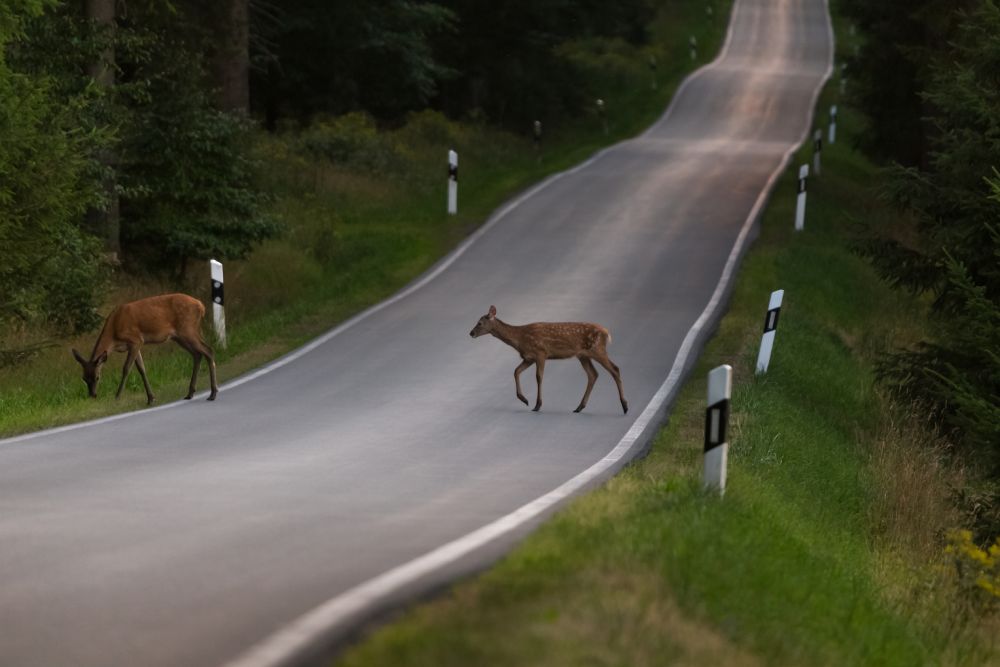
It's 6:40 on a November morning. You're southbound on SR 3 with the heater still catching up, and a doe comes out of the treeline with no warning at all. Now you're on the shoulder with a folded hood and a headlight hanging by its harness.
Here's the order that actually helps — and the parts most drivers get backwards.
Indiana reports more than 14,000 deer-vehicle collisions a year, and they are not spread evenly. October through December is the peak, and November is the worst month of the year. The dangerous windows are roughly 5–8 a.m. and 5–8 p.m. — which, in Noble and Wabash counties, is exactly when people are driving to and from work on the roads deer like best.
We know, because those are the weeks our bays fill up.
The first ten minutes
1. Get off the road, then worry about the car.
Hazards on, and if the vehicle moves, get it fully onto the shoulder. On SR 3 and US 6 the traffic behind you is doing 55 and it's still dark. A second impact is a far bigger problem than the first one.
2. Do not approach the deer.
Indiana DNR is blunt about this: a wounded deer is unpredictable and dangerous. It may look finished and not be. Stay in the vehicle or well clear of it.
3. Call the police.
Non-emergency is fine if nobody's hurt. Two reasons this matters more than people expect: the report is what your insurer will ask for, and an officer is one of the few people who can legally deal with the deer.
4. If you want to keep the deer, you need a permit.
You cannot simply load it up. A local or state police officer, a DNR conservation officer, a DNR district biologist, or a DNR property manager can issue a permit to keep it — or arrange donation through the Hunt for Hunger program. Selling wild deer meat is illegal in Indiana, full stop.
5. Photograph more than the damage.
Everyone shoots the crumpled fender. Also shoot: the whole vehicle from each corner, the road and mile marker, any fluid on the pavement, the inside of the engine bay if the hood will open, and your odometer. Adjusters settle faster on files that don't need follow-up questions.
The part almost everybody gets wrong
Hitting a deer is a comprehensive claim, not a collision claim.
Comprehensive covers things outside your control — animal strikes, hail, a tree limb. Because there's no other driver and no fault to assign, a deer strike is generally not treated as an at-fault accident. In many states rates don't move at all for it, though that depends on your state and your carrier, so ask yours directly.
Now the exception that catches people:
If you swerve and miss the deer, it's a different claim.
Swerve into a guardrail, a ditch, a mailbox or another vehicle, and you've had a collision — which means collision coverage, your collision deductible, and potentially fault. Hit the other driver, and you may be liable for their damage too.
This is genuinely counterintuitive. The instinct that feels responsible in the moment — jerk the wheel, miss the animal — is the one that turns a no-fault comprehensive claim into an at-fault collision claim. Every defensive driving course in the state says the same thing: brake hard, stay in your lane.
Worth knowing before you call your agent, and worth knowing at 6:40 a.m. on SR 3.
Why a deer strike is rarely "just a bumper"
A deer weighs 120 to 200 pounds and hits high. That's the difference between a deer strike and a parking lot scrape, and it's why we spend more time on these than the outside of the car suggests.
What's behind the bumper cover. On most vehicles built in the last eight years, the front fascia is where the radar sensor for adaptive cruise, forward collision warning and automatic emergency braking lives. Remove or replace that bumper and the radar's position relative to the vehicle centerline changes. It has to be recalibrated — the same kind of ADAS work we handle with glass and collision repairs. The same goes for the forward-facing camera behind your windshield if the glass is replaced, and for anything that changes ride height or steering geometry.
Skip the calibration and the car still drives. It just no longer judges distance correctly — a forward collision warning that fires late, a lane-keep that reads the markings wrong, automatic braking that misjudges the gap. You'd have no way of knowing until the moment you needed it.
What's behind the grille. Radiator, condenser, cooling fans, sometimes the intercooler. A radiator that's weeping rather than gushing will get you home and let go on the way to work.
Where the energy went. Deer strikes push energy into the upper rail and the core support. Damage there doesn't show up in a walkaround — it shows up on a measuring system, after teardown.
This is the honest reason a deer estimate written in the parking lot often grows once the front end is apart. It's not a bait-and-switch; it's that the first look genuinely cannot see the radar bracket or the rail. That's what a supplement is, and we'd rather explain it up front than surprise you with it.
What we do with it
Bring it to Kendallville or North Manchester and the sequence is the same:
- A real look, not a guess. Teardown where it's warranted, measured on the bench if the strike reached structure.
- Sensors handled as part of the repair. Radar and camera calibration is documented and included — not treated as an optional line the adjuster can talk us out of.
- We deal with your carrier. We're preauthorized with the major ones. If a supplement is needed, we file it, photograph it, and follow it up. You're not the one on the phone arguing about a bracket. And picking us is a recommendation your insurer makes, not a requirement you have to follow.
- Rental and towing sorted. Enterprise keeps vehicles at our collision centers. If yours isn't drivable, call us before you call anyone else and we'll arrange the tow.
You don't need a claim number to get an estimate. No appointment needed for an estimate if you can bring the vehicle in — or call first if you need a tow.
If it happened this morning
Call the shop nearest you. If the vehicle moves, bring it in. If it doesn't, call first and we'll arrange the tow.
Kendallville — 550 W North St · 260-347-1400
North Manchester — 1002 W Indiana 114 · 260-344-8713
Mon–Fri, 8:00 a.m. to 5:00 p.m. Free pickup and delivery across Noble and Wabash counties.
Frequently asked
- Do I have to report hitting a deer in Indiana?
- Call the police. Even with no injuries, the report is what your insurer will ask for, and an officer is one of the few people who can issue a permit for the deer or arrange donation.
- Does insurance cover hitting a deer?
- Yes, under comprehensive coverage, if you carry it. Comprehensive covers animal strikes because they're outside your control. You'll pay your comprehensive deductible.
- Will hitting a deer raise my rates?
- Usually not, because it's generally not treated as an at-fault accident. It varies by carrier and state, so ask yours — but it's a different category from a collision you caused.
- What if I swerved and hit something else instead?
- That's a collision claim, not a comprehensive one. Different deductible, and potentially fault — especially if another vehicle or someone's property was involved.
- Can I keep the deer?
- Only with a permit. A local or state police officer, DNR conservation officer, DNR district biologist or DNR property manager can issue one, or arrange donation through Hunt for Hunger. Selling the meat is illegal in Indiana.
- How long does deer damage take to fix?
- It depends on what's behind the bumper. A cover and a headlamp is a short job. Anything touching the radiator, the radar sensor or the upper rail takes longer, and parts availability drives the rest. We'll tell you after teardown, not before.
- Can I choose my own shop?
- Yes. Your insurer may recommend one. They cannot require it, and your policy pays the same either way.